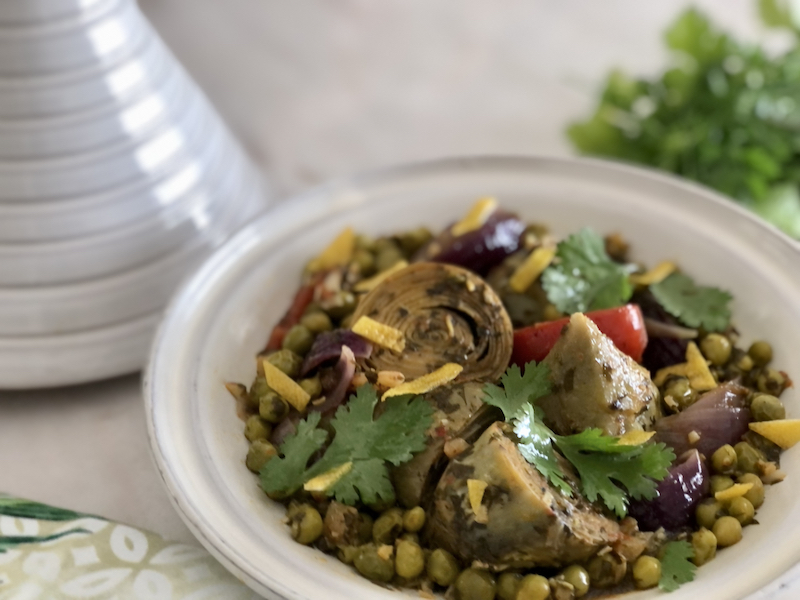
Have you ever visited Morocco? You should! In my recent trips I’ve been astounded by the delicacy of its vegetables cooked in the Tajine. Carrots, zucchini, turnips or green beans, flavored with fresh herbs and spices and perfectly cooked. The tajine or tagine (from Berber ⵟⴰⵊⵉⵏ ) is a circular earthenware container with a conical lid and which gives its name to the dishes cooked in it. Today we bring you our version of Artichoke Tajine with Peas, a Southern Mediterranean traditional dish, iconic for its fresh flavors and which allows us to cook with one of the healthiest techniques: steam and low temperature.
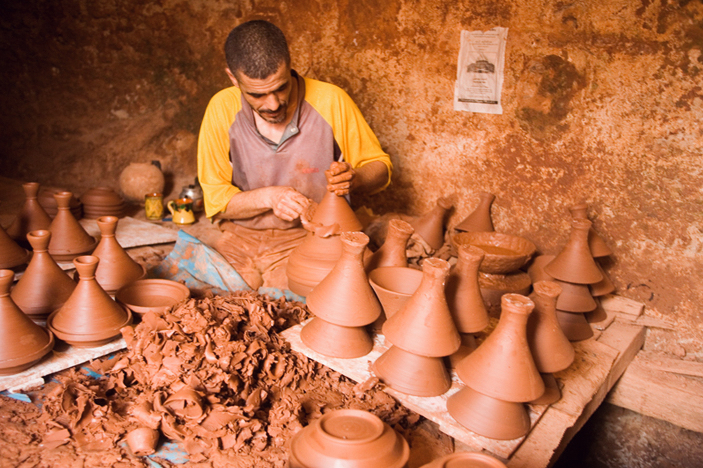
Tajine cooking is a closed pot technique simmering at low temperature with very little water. This renders food at a point of perfect flavor and texture. Thanks to its chimney-shaped lid, vegetables are cooked in circular steaming, increased by the drops of water that condense on the inside of the lid and fall on the food during cooking.
For the correct preparation of a vegetable tajine we must follow these steps:
- Prepare a marinade (herbs, spices and aromatics) with olive oil in a large bowl. In our artichoke tajine we combine coriander, parsley, garlic, ginger, lemon, Ras el Hanout, Harissa, pepper and salt.
- Clean and peel the vegetables, carefully cutting them into slices, sticks, quarters or halves depending on their size. At first, we must orient ourselves by the recipe since the type of cut will determine its cooking.
- Add the vegetables to the marinade and wrap them with the mixture. Without letting them rest, we place them on the tajine plate.
- We place the hardest vegetables (potatoes, carrots, turnips, etc.) at the base and the softest ones (zucchini, onions, artichokes, green beans, etc.) on top.
- Add water to the rest of the marinade that has remained in the bowl and pour over the vegs.
- Cover the tajine and cook over low heat, checking the cooking point and the amount of water in the bottom after 30-45 min.
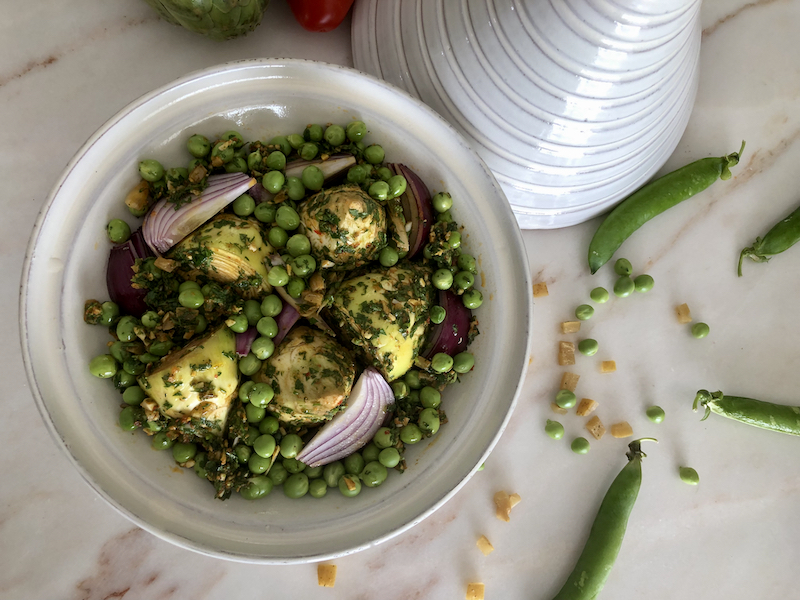
In the picture you can see the tajine already assembled ready to go to the fire.
To see the details of the technique, we suggest you read the description of the recipe (below) or watch the video with a traditional Berber Vegetable Tajine by Moroccan chef Dada Rabiaa. It is curious that cooking in the Tajine combines three of the cooking styles that have become fashionable recently: steam cooking, low temperature and One-pot Meal recipes.
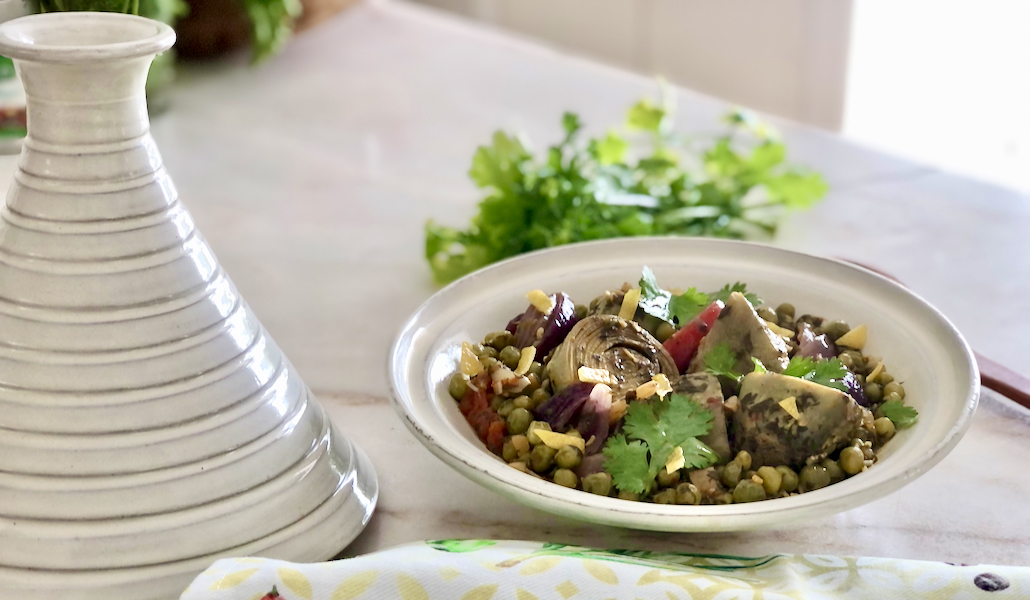
Do not forget the Tajine is a legendary tool. The Berbers of southern Morocco prepared the tajine in the morning and buried it in the sand, leaving its chimney protruding from the ground. After a day of work, when they returned in the afternoon, the Tajine was ready to eat. We are not going to do that… but we are getting the same result: delicious!
When we lift the lid of our Artichoke with Peas Tajine, we are inundated with the aromas of Morocco: ginger, spices, lemon and coriander. Artichokes made al dente with their flavor accentuated by hints of lemon and fresh herbs. A soft spicy tone unites the entire dish. The stew sauce is a treasure: the Moroccan Atlas, the Berbers, the desert, Southern Mediterranean… all in one plate.

- 6 artichokes, cleaned, peeled and soaked in water with a squeeze of lemon juice
- 200 g shelled fresh peas
- 1 red onion
- 2 garlic cloves
- 1 piece of fresh ginger (about the size of two garlic cloves)
- 1 bunch of parsley
- 1 bunch of coriander
- 1 tablespoon Ras el hanout
- 1-2 teaspoons Harissa (optional)
- 50 ml olive oil
- ½ Moroccan lemon (preserved in salt)
- Sea salt
- Black pepper
- 200 ml of mineral water
- In a large bowl prepare a marinade by combining the finely chopped coriander, parsley, garlic and ginger. Add the oil.
- Remove the pulp from half a preserved lemon and chop the skin into squares. Add it to the bowl along with the spices Ras el Hanout, Harissa, pepper and salt. Stir well until a uniform paste is formed.
- Peel and cut the onion into quarters and add them to the marinade along with the artichokes and wrap them with the mixture.
- Without letting them rest, place the artichokes in the center of the tajine plate with their base down. Place the onion in the gaps between the artichokes.
- Add the peeled peas to the bowl of the marinade and stir well so that they are well soaked. Distribute them evenly on the tajine plate.
- Add the water to the bowl and stir again. Pour the water with the rest of the marinade over the vegetables in the tagine.
- Cover the tagine and place it over a low heat.
- After 30 min. open and check the cooking point of the artichokes and that there is liquid in the bottom. If necessary add a finger of water and continue cooking covered for 10-15 more minutes.
- When serving, garnish with fresh coriander and bits of lemon peel.
 Toni and Javi are active daily cooks who explore the beauty of natural cooking. Our mission is to bring flavor and excellence to healthy eating!







Leave a Reply